|
Beating
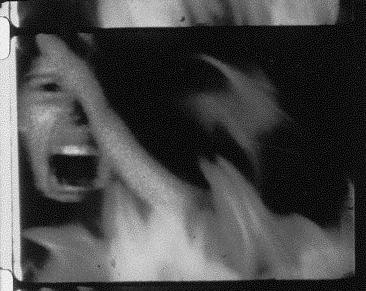
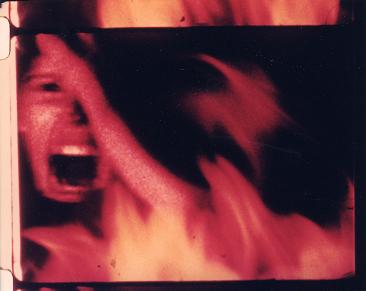
“Beating” — to get beaten or give a beating, to beat oneself up. To beat the odds. Metal is forged by beating. Birds beat their wings, the sun beats down, and our hearts... Under this central trope of 'beating', with its combined negative and positive implications, the film brings together the individual personally lived and the communal, historic perspective; hatred and forgiveness; laughing and crying. Also brought in relation: the politics of gender and the holocaust; the Old World and North America. Passages of emotion - our lives as we experience them today - move through a terrain of memory and anlaysis. Beating exists in the area of boundaries. I work with images as they can be registered between abstraction and representation, between blurred and defined, between the formless and the formed in-between, in motion. I try to render images suggestively, bodily and to use vocalizations and words for texture as well as information. "Water, like fire, is a dimension of the carnival insisting on the stateless and the flux... a world in which hierarchies were collapsing, boundaries dissolving... a state of becoming, not of being." (Robert Kroetsch) The film's surface, scratched and mottled, negative and positive, black & white and colour bears witness to storms of emotion. From section to section, repetitions occur, connections are made—reminiscences, equivalences between different images—to achieve the feeling or recognition that everything is related. It is all there all the time. (B.ST) “With Beating, Sternberg's work moves into new territory as she focuses on the tactile nature of film (through bleaching, scratching, bipacking and re-filming), as well as taking on a much more haunting vision. Body parts, statues, birds in flight and sepia-toned images of Jews in prison camps take on an astounding and breathtaking rhythm. In Sternberg's words "Beating considers horror/fascination, evil/good, dark/light, and the relation between these terms, the one the flip side of the other... Beating looks at and listens to the parts of ourselves (myself) hidden in the shadow." A jarring and potent soundtrack blends silence with natural human sounds (groans, sighs, yells) and history's voices. Beating stands as one of Sternberg's finest films to date and a testament to her constant re-examination of the self and its relationship to the history it is caught in.” (Alex MacKenzie, Blinding Light Cinema) "This supremely lyrical ‘beating’ makes some brutal connections." (Peter Goddard, Toronto Star)
Beating credits Available from:
Canadian Filmmakers' Distribution Centre Lightcone |
|
| Beating Transcript | ||
| Reviews/Articles: | ||
| "This supremely lyrical Beating makes some brutal connections" by Peter Goddard; The Toronto Star, April 6, 1995. | ||
| Kika Thorne, Pleasure Dome Programme Notes | ||
| Letter by James Baker Hall | ||
| "Panorama: Four Films by Barbara Sternberg" by Rae Davis, April 8, 1996 | ||
| Cameron Bailey, Now Magazine, April 6, 1995 | ||
| Matriart,
vol. 6 #2&3 summer '96 "Beating", by Barbara Godard |
||
Jeffrey Lambert, San Francisco Cinemateque Programme Notes
|
||
Beating from B.Sternberg on Vimeo. | ||